Anti-dueling edicts
The Three MusketeersThe Anti-dueling edicts are the legal prohibitions against private sword fights in seventeenth-century France. Their decisive function in the narrative is paradoxical: by forbidding the practice most closely associated with gentlemanly honor, they make every duel a contest not only between combatants but also between personal courage and public law, and between the authority of Louis XIII and that of Cardinal Richelieu.
Definition and Political Setting
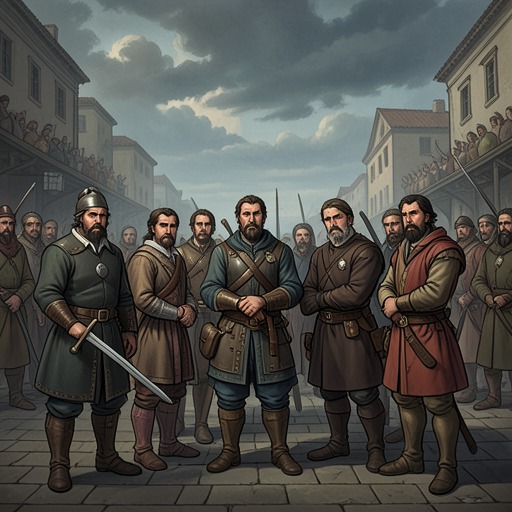
The edicts belong to a society already accustomed to violence. In 1625, nobles fought one another, the king fought the cardinal, Spain fought the king, and robbers, mendicants, Huguenots, wolves, and criminals were imagined as making war upon everyone. Citizens therefore treated sudden alarms as ordinary features of public life, taking up arms readily against many threats while remaining cautious about opposing the cardinal or Spain. Within this world, the prohibition of dueling did not remove violence; it distinguished unauthorized private combat from violence tolerated or directed by political power.
The legal rule also operated within the rivalry between the king and the cardinal. Louis XIII made M. de Treville captain of the Musketeers, while Richelieu created a competing guard of his own. Although both rulers publicly condemned duels and brawls, they privately delighted in the courage of their men and encouraged competition between the two armed households. The edicts thus existed beside a political culture that rewarded the very swordsmanship they officially restrained.
How the Edicts Shape Gentlemanly Conduct
M. d'Artagnan the elder presents the contradiction openly when he advises d'Artagnan the younger never to fear quarrels and to fight all the more because duels are forbidden. In his account, the legal prohibition increases the courage required for combat: a gentleman who fights risks not merely injury but punishment, and therefore demonstrates a more dangerous form of resolve. The father's counsel makes the edicts part of a code of masculine and aristocratic self-fashioning. Obedience to the law may be expected, but hesitation before an insult threatens the family name and the identity of a gentleman.
The same tension appears when d'Artagnan proposes to postpone his duel with Athos for three days so that Athos's wound can heal. Athos recognizes the gesture as gallant, yet explains that the cardinal's age makes secrecy impossible: a planned combat would become known and be prevented. The edicts therefore shape the timing and form of violence. They do not end the quarrel; they force combatants to conceal it, accelerate it, or transform it into something that can be represented as an exceptional encounter.
The Duel at the Carmes-Deschaux
The decisive test comes when Athos, Porthos, and Aramis are confronted by five of the cardinal's Guards. Jussac invokes the edicts and orders the Musketeers to sheath their swords and follow the Guards. Aramis answers by parodying the official language: he says that obedience would give them pleasure if it depended upon them, but that M. de Treville has forbidden it. The exchange reveals competing commands, with the state prohibition opposed by the captain's authority and the Musketeers' loyalty to their own institution.
The situation becomes a choice between the king and the cardinal. D'Artagnan understands that fighting violates the law, risks his life, and creates an enemy in a minister more powerful than the king himself. He nevertheless refuses to stand aside, declaring that although he does not yet wear the uniform, he has the spirit of a Musketeer. His decision converts a private newcomer into a political participant. The Anti-dueling edicts make the choice costly, but their existence also gives the choice its moral and dramatic weight: d'Artagnan knowingly accepts illegality in order to join Athos, Porthos, and Aramis.
After the fight, M. de Treville protects his men by distinguishing the encounter from an ordinary duel. Before Louis XIII, he argues that it was a brawl because five of the cardinal's Guards had attacked three Musketeers and d'Artagnan. The king accepts the distinction sufficiently to summon the four men privately, while still insisting that an edict remains an edict and that fighting is forbidden. The rule is therefore neither simply enforced nor simply abandoned. It is reclassified when political loyalty and the unequal numbers of the combatants make such a classification useful.
Enforcement, Evasion, and Double Standards
The contrast between the two guards exposes the edicts' uneven enforcement. M. de Treville angrily tells his Musketeers that the cardinal's Guards are brave, quiet, and skillful because they never place themselves in a position to be arrested. His reproach is deliberately humiliating: the king's Musketeers have allowed themselves to be caught, while the cardinal's men appear to preserve both their honor and their freedom. Yet the cardinal's Guards are not less martial. They are simply more successful at operating within, around, or beyond the law.
The broader machinery of arrest is equally political. A secret police trap can close a house to all who enter, accumulating prisoners over several days. M. de Treville protests when police officers and procurators arrest Athos, lead him through the open street, and throw him into Fort l'Eveque without showing the order authorizing the action. The episode places the anti-dueling principle beside another legal danger: a state that condemns unauthorized violence may itself use secret detention and opaque procedures. The edicts consequently appear within a wider system in which legality can be invoked against soldiers while authority remains difficult to inspect.
M. de Treville challenges the persecution of Athos by insisting that the case should go before judges, and Louis XIII agrees that judges must decide it. Yet Treville also warns that even an unblemished life and incontestable virtue cannot protect a man from infamy and persecution in such times. The legal process is presented as preferable to arbitrary punishment, but its existence does not guarantee impartial protection. The same political order that forbids dueling can expose a soldier to police power merely by associating him with a prior violent encounter.
Narrative Significance
The Anti-dueling edicts make law a recurring pressure on the novel's central friendships. They turn the first solidarity of d'Artagnan, Athos, Porthos, and Aramis into an act of shared risk, and they allow their fellowship to be defined against the rival power of Richelieu's Guards. Their motto and conduct are not formed in a lawless vacuum; they acquire meaning because the law threatens to punish the very loyalty that makes them a company.
The rule also clarifies the novel's larger political structure. The king and the cardinal compete through armed retainers while officially condemning the quarrels that display their retainers' value. The edicts therefore mark the boundary between sanctioned and unsanctioned force, but the boundary is repeatedly redrawn by rank, numbers, institutional allegiance, and political convenience. Even later, when the cardinal asks whether those who punish without authority are assassins, the question extends the same problem beyond dueling: who possesses the right to punish, and what happens when men claim justice without a license to exercise it?
The edicts ultimately function less as a stable prohibition than as a measure of power. For d'Artagnan, disobeying them proves courage and wins entry into the Musketeers. For M. de Treville, their interpretation becomes a means of protecting loyal men. For the king and the cardinal, their enforcement is subordinate to rivalry between competing armed establishments. The law remains real because it can threaten lives, yet it remains politically unstable because those who wield authority can redefine the violence before them.